
a lectio divina theme: aging & dying well
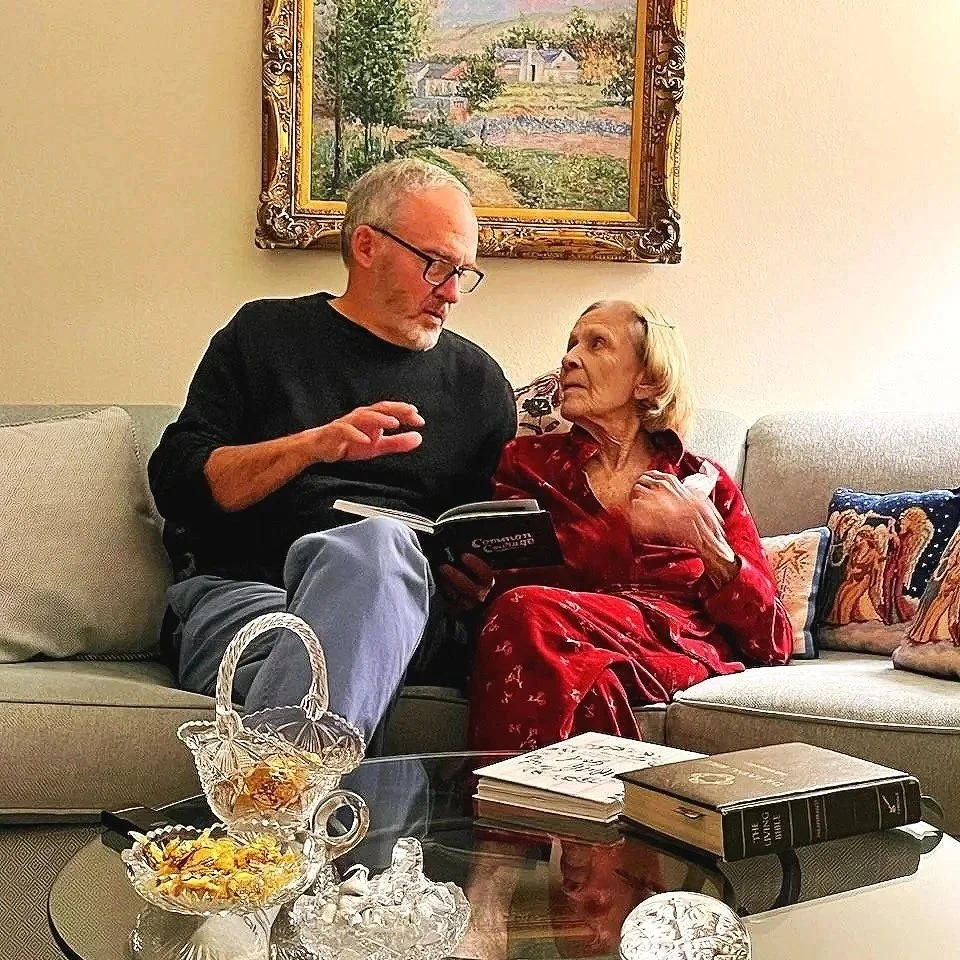
My mother at 92, was perhaps doing her best (and hardest) work of her life. And a few noticed. it was even easy for me to miss its beauty and merely await her passing and manage her affairs, living a busy full life myself. But the aged teach us about aging, something we are unable to value, an elective we don’t select earlier in life, until we are getting closer ourselves or comes to us unannounced. She is teaching a master course on grace, solitariness, involuntary diminishment, ultimate hope, and on noticing ever present natural beauty and in welcoming visitors, known and unknown who come to see her. —PRH
They .. came in even larger numbers to the place where he was staying. He witnessed to them from morning till evening, explaining about the kingdom of God… he tried to persuade them about Jesus. … For two whole years Paul stayed there in his own rented house and welcomed all who came to see him. He proclaimed the kingdom of God and taught about Jesus Christ—with all boldness and without hindrance. —- apostle Paul, at end of his life in Roman prison; last of Acts of Apostles, ch. 28: 23, 30.
elegy , by Wendell Berry, for his friend, neighbor and mentor, Owen Flood; from the wheel, 1982
The best teachers teach more
Than they know. By their deaths
They teach most. They lead us beyond
What we know, and what they knew.
Thus , my teacher, my old friend,
Stood smiling now before me, wholly
Moved by what had moved him partly In the world.
…But though our outer man is decaying, yet our inner man is being renewed day by day. For momentary, light affliction is producing for us an eternal weight of glory far beyond all comparison, while we look not at the things which are seen, but at the things which are not seen; for the things which are seen are temporal, but the things which are not seen are eternal. --- Paul to Corinth
I first read the phrase “first half of life” in the work of Swiss psychologist Carl Jung years ago. It made sense to me then, but I probably was too young at that point to recognize how true it would eventually become. In short…he would say that the first half of life is the task that we think is our primary task. The 2nd half of life is really the task within the task that a lot of people never get to because they’re so preoccupied with the first task, which is all about making money, getting an education, raising children, and paying a mortgage. It’s about tradition, law, structure, authority, and identity. It’s about why I’m significant, why I’m important, why I matter, why I’m good.
Most of us are so invested in these first-half tasks by the age of forty that we can’t imagine there’s anything more to life. But if we stay there, it remains all about me. How can I be important? How can I be safe? How can I be significant? How can I make money? How can I look good? And how can I die a happy death and go to heaven? Religion itself becomes an evacuation plan for the next life because we don’t see much happening of depth or significance in this world. It largely remains a matter of survival. Bill Plotkin, who’s been such a wonderful influence on so many people in recent decades, speaks of the first half of life as our survival dance, and the second half of life as our sacred dance. Most people never get beyond their survival dance. It’s just identity questions, boundary questions, superiority questions, and security questions. We would call them ego questions, but they’re not questions of the soul. —-Fr. Richard Rohr
In Maurice Sendak's (the author and illustrator) last interview, he said,
I cry a lot because I miss people. I cry a lot because they die, and I can’t stop them.
They leave me, and I love them more . I’m finding out as I’m aging that I’m in love with the world…
quoting Sendak, author John Green: in later years, I’m beginning to fall in love with the world. To fall in love with the world, is not to ignore or overlook human suffering. But it is to look up at the night sky and feel your mind swim before the beauty and the distance of the stars, to hold your children while they cry, to watch as the sycamore trees leaf out in June; when my breastbone starts to hurt and my throat tightens and tears well in my eyes, I want to turn away from feeling , I want to deflect with irony or anything else that will keep me from feeling directly. We all know how loving ends. But I want to fall in love with the world anyway, to let it crack me open. I want to feel what there is to feel while I am here. — from green’s: The Anthropocene Reviewed book of essays
“Lord,” Martha said to Jesus, “if you had been here, my brother (lazarus) would not have died. But I know that even now God will give you whatever you ask.” Jesus said to her, “Your brother will rise again. Martha answered, “I know he will rise again in the resurrection at the last day.” Jesus said to her, “I am the resurrection and the life. The one who believes in me will live, even though they die; and whoever lives by believing in me will never die. Do you believe this?”--- John’s gospel 11: 21-26
Unless a grain of wheat falls into the earth and dies, it remains alone; but if it dies, it bears much fruit.--john 12:24 , Jesus
Bedside Manners, poem by Christopher Wiseman [sent to me by brother David Harrison, March 10, 2006]
How little the dying seem to need--
A drink perhaps, a little food,
A smile, a hand to hold, medication,
A change of clothes, an unspoken
Understanding about what’s happening.
You think it would be more, much more,
Something more difficult for us
To help with in this great disruption,
But perhaps it’s because as the huge shape
Rears up higher and darker each hour
They are anxious that we should see it too
And try to show us with a hand-squeeze.
We panic to do more for them,
And especially when it’s your father,
And his eyes are far away, and your tears
Are all down your face and clothes,
And he doesn’t see them now, but smiles
Perhaps, just perhaps because you’re there.
How little he needs. Just love. More love.
“Who has not seen, as the infirmities of age grow upon old men, the haughty, self-reliant spirit that had neglected, if not despised the gentle ministrations of love, grow … a little scared, and begin to look about for some kindness; begin to return the warm pressure of the hand, and to submit to be waited upon by the anxiety of love?" —-George MaDonald, Adela Cathcart, vol. 3, ch. 7
To laugh often and love much, to win the respect of intelligent persons,
and the affection of children; to earn the approbation of honest critics
and endure the betrayal of false friends; to appreciate beauty,
to find the best in others; to give one’s self;
to leave the world a bit better, whether by a healthy child, a garden patch
or a redeemed social condition; to have played and laughed with enthusiasm
and sung with exultation; to know even one life has breathed easier
because you have lived --this is, to have succeeded. —ralph waldo emerson
—…and He will wipe away every tear from their eyes; and there will no longer be any death; there will no longer be any mourning, or crying, or pain—-the first things have passed away.”--Revelation 21:4
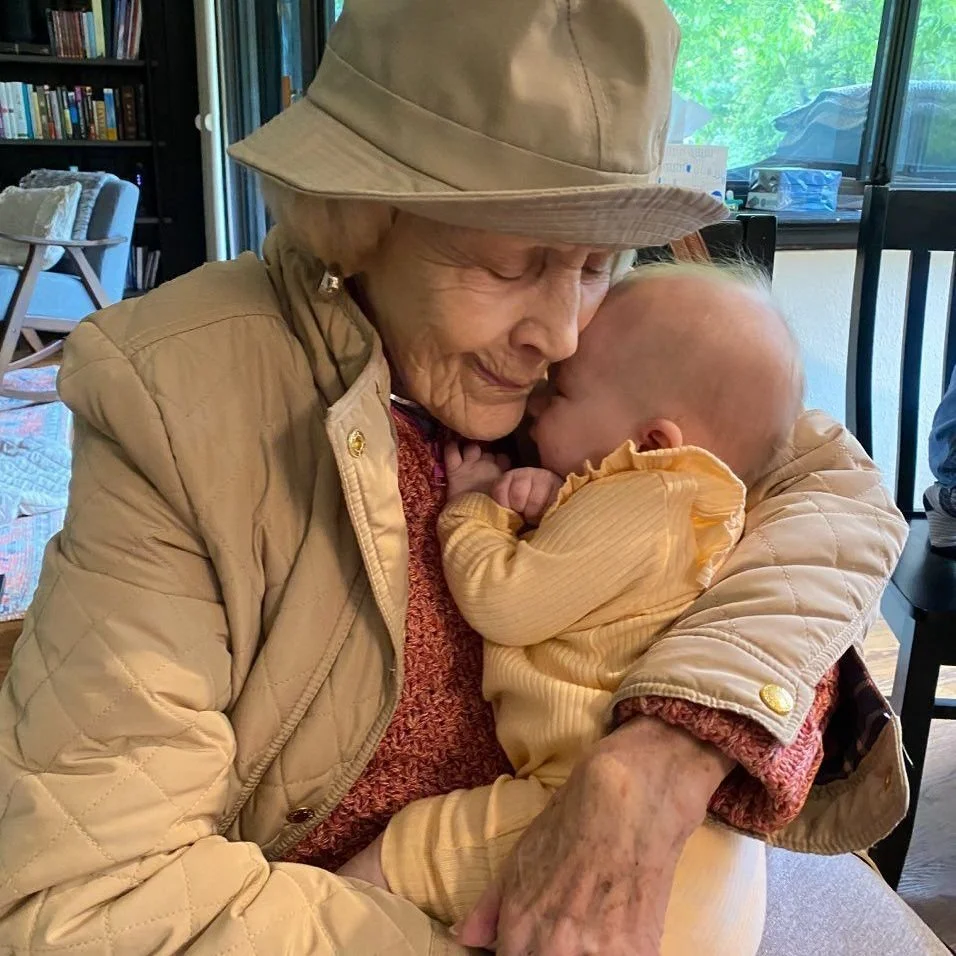
Marilyn Jane Harrison passed March of 2024 at age 93. Here she holds her third great grandchild, Rita Jane Harrison.
All donations go directly to Pat & Sarah’s work of welcoming presence, spiritual friendship, pastoral care, and stewardship of land;
Also donations support Pat’s writings. (suggested: $20-$40/mo)
Subscribe to receive weekly writing posts at the bottom of any website page
To donate, go to ‘support’ page here: