
a lectio divina: the way of love, part one
Love, like forgiveness, is a decision. It’s a decision in our minds and in our hearts. And we’d better make it early in the day, because once we’re a few hours into low-level resentment, anger, or disappointment, it’s too late. When we’re not choosing love, we’ll use any excuse to be unhappy or irritated. We’re already unhappy, and then something gives us an excuse to externalize it. The exact object for our unhappiness is actually arbitrary. Unhappiness just needs an object—as do happiness and love. We have to recognize ahead of time when we’re not living in love. This is surely why a morning prayer or practice is so important—to allow us to choose to love each and every day. — Fr. Richard Rohr
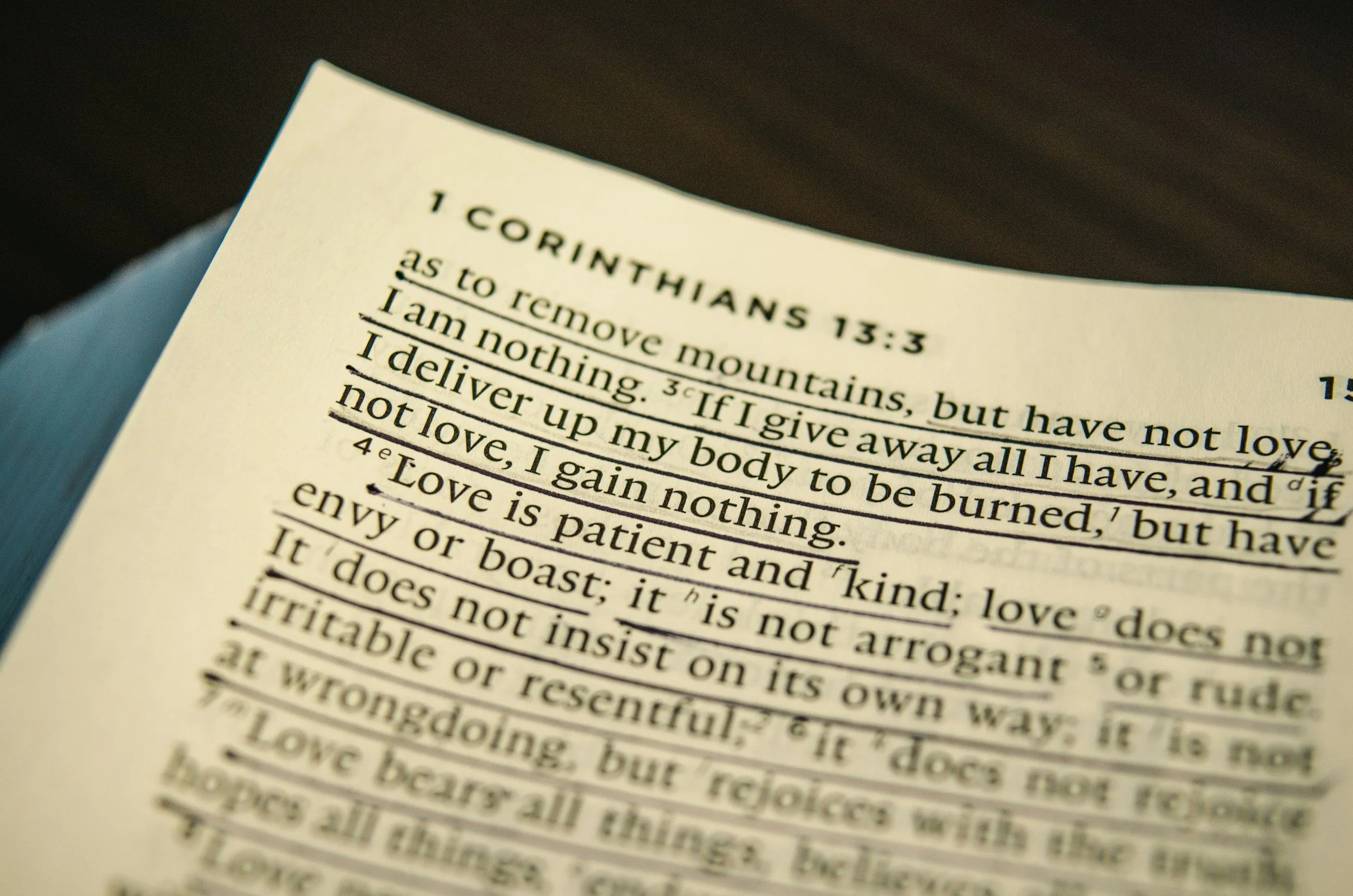
St. Thérèse of Lisieux came to an important realization when reflecting on First Corinthians 13, which explains that all the greatest gifts are nothing without love. This led Thérèse to understand that love enabled the apostles to preach and the martyrs to make their great sacrifices. Love kept the body of Christ alive in the world. She wrote in her autobiography, “I understood that love comprised all vocations, that love was everything, that it embraced all times and places.... In a word, that it was eternal!” -—-from Thérèse of Lisieux, (1873-1897) pg. 27; autobiography, story of a soul; John Clarke, translator
What I saw most clearly was that love is his meaning. God wants us to know that he loved us before he even made us, and this love has never diminished and never will. — —Julian of Norwich
Love [people] even in [their] sin, for that is the semblance of Divine Love and is the highest love on earth. Love all God’s creation, the whole and every grain of sand in it. Love every leaf, every ray of God’s light. Love the animals, love the plants, love everything. If you love everything, you will perceive the divine mystery in things. Once you have perceived it, you will begin to comprehend it better every day. And you will come at last to love the whole world with an all-embracing love. ——Fyodor Dostoyevsky, The Brothers Karamazov
…the best portion of a good person’s life is ‘the little, nameless, unremembered acts of kindness and love.’ —William Wordsworth quoted in Theo of Golden, by Allen Levi; pg. 217
To love someone is to grant him or her the gift of one’s pure and undivided attention, without preconceived expectations of what the other person needs, what we imagine to be best in the situation, what particular results we want to engineer. This is a love finally purged of the ego’s calculating desires, a love without strings. It contemplates other people with the same wonder it has found in contemplating God. The choice is simple, as Alan Jones contends: “‘we either contemplate or we exploit’. We either see things and persons with reverence and awe, and therefore treat them as genuinely other than ourselves; or we appropriate them, and manipulate them for our own purposes”. ——Belden Lane, The Solace of Fierce Landscapes, p. 202
The Way of Love ; Eugene peterson, the Message; first corinthians 12:31- 13:13, by apostle Paul
But now I want to lay out a far better way for you.
If I speak with human eloquence and angelic ecstasy but don’t love, I’m nothing but the creaking of a rusty gate.
If I speak God’s Word with power, revealing all his mysteries and making everything plain as day, and if I have faith that says to a mountain, “Jump,” and it jumps, but I don’t love, I’m nothing.
If I give everything I own to the poor and even go to the stake to be burned as a martyr, but I don’t love, I’ve gotten nowhere. So, no matter what I say, what I believe, and what I do, I’m bankrupt without love.
Love never gives up.
Love cares more for others than for self.
Love doesn’t want what it doesn’t have.
Love doesn’t strut,
Doesn’t have a swelled head,
Doesn’t force itself on others,
Isn’t always “me first,”
Doesn’t fly off the handle,
Doesn’t keep score of the sins of others,
Doesn’t revel when others grovel,
Takes pleasure in the flowering of truth,
Puts up with anything,
Trusts God always,
Always looks for the best,
Never looks back,
But keeps going to the end.
Love never dies. Inspired speech will be over some day; praying in tongues will end; understanding will reach its limit. We know only a portion of the truth, and what we say about God is always incomplete. But when the Complete arrives, our incompletes will be canceled.
When I was an infant at my mother’s breast, I gurgled and cooed like any infant. When I grew up, I left those infant ways for good.
We don’t yet see things clearly. We’re squinting in a fog, peering through a mist. But it won’t be long before the weather clears and the sun shines bright! We’ll see it all then, see it all as clearly as God sees us, knowing him directly just as he knows us!
But for right now, until that completeness, we have three things to do to to lead us toward that consummation: Trust steadily in God, hope unswervingly, love extravagantly. And the best of the three is love.
All donations go directly to Pat & Sarah’s work of welcoming presence, spiritual friendship, pastoral care, and stewardship of land;
Also donations support Pat’s writings. (suggested: $20-$40/mo)
Subscribe to receive weekly writing posts at the bottom of any website page
To donate, go to ‘support’ page here: